Sunday, January 05, 2014

Narration vs Dialogue and Action - Where it Fits in the Toolbox

The other day, I went searching for some blog posts on narrative. I'd found some very useful ones on plot previusly, and although I like to make things up as I go along, I do like my stories to have some sort of structure to refine. So I read a lot about plot and use it in my revisions.

But when I googled narrative, most of the more popular articles were about cutting it out all together.

This... confuses me, because you have to describe things. Nobody needs 20 pages of sunset descriptions, but we're not writing a script here either. This is not talking heads, it's a book. Part of the best thing about fiction is how it can get into people's heads - it's one up it has on other narrative forms. The Book Thief comes out in cinema's soon, and I have no idea what they're going to do with it, because the more important parts of that book happen in narrative and the thoughts of the characters and the narrator, which is Death.

So I'm left with the same issue as before - I know narrative is important, but how to write good narrative is something I'm still trying to figure out. There's several ideas that I plan to explore. Firstly, what narrative is good for vs what dialouge and action are good for. That's this post. Then, in consecutive order

But why do we need narrative anyway? It's just describing things, isn't it? Well, maybe. But narrative breaks up large chunks of dialoug, helps to anchor the reader to the story, and gives the brain something to follow. Narrative also works very well as a form of exposition - how you describe a world and a story ties into how the character sees that world. It shows us details we wouldn't be able to see otherwise - thoughts and consequences and information that can't be shown in a visual medium. I've mentioned previously that sometimes you need to tell, rather than show, because there's only so much information that can be gathered from watching someone do something. Narrative gives us a window into the unseen. As such it should not be overused, because overused, it becomes condescending - you're taking the hand of the reader and telling them how to think and feel about a situation.

But it is, in itself important, and it is purely unique to prose. And while movies and plays can do many many things, one of the things that fiction is best at, is looking into the unseen.


Enjoy All,

Sian

Friday, January 03, 2014

10 things Books and Movies tend to get Wrong about Injury

Okay. Before we start, here's a brief bit of background - I am a student paramedic in Australia. Two things to concentrate on there: Student, and Paramedic. This information should be in no-way used to diagnose, treat, or presume anything about any injury, illness or infirmity. Go to your doctor. That's what they spend the 10 years at university for - I'm only there for the length of a bachelor's degree.

That being said, here at 10 things that annoy me beyond all measure when I'm reading a book or watching a movie regarding injury:

10. Other signs and symptoms (or breathing, nausea, dizziness)


Possibly the easiest to forgive - people tend to focus in on the most obvious symptoms when describing pain. The fact of the matter is that pain produces a response in the human body, which often includes an increased breath rate, panic, and then dizziness and nausea as part of the panic.  However, every patient reacts differently, so not everyone displays these signs and symptoms. Just be aware that if someone is in enough pain to have difficulty breathing, there is a high possibility they will hyperventilate and make themselves dizzy and nauseous. Take care of the pain, and you take care of all the other issues.


9. Recovery Time


A broken bone is going to take a good 6 weeks to recover from, a stab wound or a significant bleed at least a month, maybe two. And even after the initial recovery time has passed, it will again take a fair amount of time in rehab for that person to come back to full strength and capability. The body is capable of amazing things, but be aware that tackling someone to the ground after being stabbed, while possible, is not going to have a good outcome for the person who was stabbed in the first place.

8. Wound care (Pressure, pressure, pressure)


Bleeding isn't that difficult to treat. Honestly, you need to place pressure on that wound until one of two things happen - the blood clots and  the person stops bleeding, or you reach a surgeon who can either stitch the wound together, or who can go and place the pressure on the wound him/herself inside an internal cavity.

That being said - a few basic principles:
  • Sterile, wet dressings. Preferably saline soaked gauze. You would use this over a simple crepe bandage because they're easier to deal with long term - fibres don't get stuck in the wound, the saline soaked gauze is easier to lift away, and you want to keep any exposed tissue moist, and prevent it from drying out
    • You can get saline from the chemist. It's used for washing contact lenses.
  • Pressure. Do not let up on the pressure. If the blood bleeds through the bandages, don't lift the initial dressing off, place another one on top. Change that one if the blood keeps flowing - the initial bandage will probably be involved in the clot that is forming, and the last thing you want to do is to lift that away.
  • Gently does it. Don't wash an open wound by chucking it under a tap. Again, saline soaked dressings, passed gently over the skin until the wound is clean, are your friends. 

 7) CPR


The number of times I have seen someone die in a TV show, and no one starts CPR boggles the mind. Some cardiac arrests are harder to get back then others. A cardiac arrest due to trauma does not have a good chance of recovery. But a cardiac arrest due to trauma that receives no CPR has much less chance of recovery.

The only time I would consider letting someone go without CPR would be if I had a decision to make about time and resources. More than one patient, the probability of a new patient very soon, danger to my own well-being. Most book and movie characters don't have these pressures. Start the CPR. 

6) Infection


If your characters have a sizable wound, and they've got it open to the world, and no access to antibiotics, expect infection. That's what killed most people before antibiotics, if your characters don't have access to a doctor of a pharmacy, it will cause issues. 

5) Panic and Anxiety


I have yet to meet a patient in clear mind who is not at least a little bit anxious. A good number of patients I've seen on placement have been more than a little bit anxious, a good chunk of them have been panicky. This response is part of the response to danger and pain - your heart rate, blood pressure and breath rate have sky rocketed to meet a threat, and your body is in adrenaline overload. Pain works very well as a natural stimulant.  Stimulation tends to induce fear and anxiety.

4) Pain


And on that - pain can be ignored, but it can only be ignored for so long.  It lingers, it aches. It interferes with your ability to do stuff. There are many many things which are more painful then they look - someone jumping from a window is going to have issues with the shock of the impact travelling up their legs. At the other end of things, there are some things which aren't as painful as they look - broken bones, for example. If you put proper tension on a broken femur, you can normally get the pain down to a manageable level. Same goes for splinting - there aren't many pain receptors in bone, it's the tearing of the covering of the bone and the damage to the surrounding issue that creates the damage. If you keep that breakage still, the pain will drop.
                                                                ---------------------------
Okay, now we're moving onto by far the things that annoy me most. They are, strangely enough, interrelated.
                                                               ----------------------------

3) Concussion


A concussion is a bruising of the brain. Nerve cells do not grow back, a concussion is not a good thing. It might not effect your character immediately, but it will come into play down the track, especially if there's more than one concussion involved. 

2) Loosing Consciousness


There are so many books and movies that use a loss of consciousness as a plot device. The character gets knocked out, and they're moved to a different location, and then we wake up and go on with everything.

It. Does. Not. Work. That. Way.

A loss of Consciousness (LOC) - happens because the brain is lacking in oxygen. Part of it is hypoxic - there are many reasons this can happen, but the ultimate point is that no oxygen = brain in shut down = brain damage. While a LOC of under five minutes is maybe something to observe and keep an eye on, an LOC of half an hour? Yeah, no, that's pretty damn serious. We're talking brain damage territory, stroke and disability territory.  In Australia there's a campaign going on about "One Punch Kills." Media has given the impression that a person can be knocked unconscious in a fight and then get up from that.

No. If a person is unconscious for 10 minutes? The patient is off to a trauma centre. Maybe even get the chopper called in.

Loosing consciousness is a big deal. Don't use it as a easy plot device.


1) Blood loss


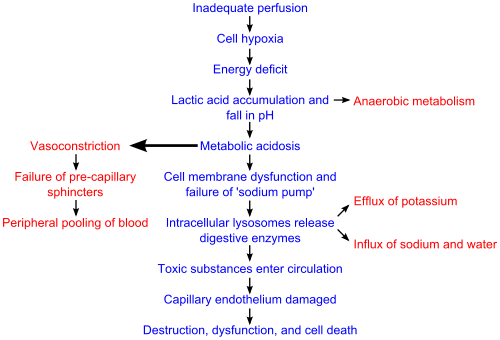
This one also annoys me. Blood loss is not something to play around with. There's a flow chart here. It's a bit complicated, but basically it's describing what happens when there's not proper delivery of oxygen and nutrients to cells and proper removal of waste from cells:

 Image accessed from : http://en.wikipedia.org/wiki/Shock_%28circulatory%29  (1)

Take note of the last one: Destruction, dysfunction and cell death.

Funnily enough, blood brings oxygen and metabolites to the cells. It also takes away waste products. So a lack of blood sets this flow chart into motion. A lack of blood = inadequate perfusion.

Honestly, I'd start to worry about the health of a person once we got past loosing about 750ml of blood. Once a person has lost enough blood to become lethargic or loose consciousness, we're in "blood transfusion plus surgery soon or they'll die" territoy.

The body just can't replace that much blood is such a short time. People don't faint from blood loss and then come back to perfect health all by themselves.


So yes, I hope that helps someone out there. Again, take note of the "student" part of the description I gave before I started this. All this is correct to the best of my knowledge, but in the scheme of things there are plenty of people who have seen a lot more than me, so use this as a jumping off point to research, rather than your only port of call.

Enjoy All,

Sian

1) For referancing purposes, it appears this image was itself based on a information from Alexander, M.F., Fawcett, J.N., Runciman, P.J. (2004) Nursing Practice. Hospital and Home. The Adult.(2nd edition). Edinburgh: Churchill Livingstone



Monday, December 30, 2013

Discovery Writing (or Pantsing) World Building - How it Informs your Plot and your Characters

Otherwise known to me as gardening. Bizarre gardening, but gardening none-the-less.

Imagine, for a moment, a plot of land. Nothing growing, nothing there but fresh, fertile soil. The sort of soil that smells of cows and sweet rotting things.

You pick a particular corner, and you start building a path. As you build this path, you scatter seeds around you, plant trees, roses, place streams and rocks down. But you only really create the garden around the path. You sort of make it up as you go along. The things you just planted inform what you next plant, but if you decide to just go ahead and whack a gum tree in the middle of a bunch of roses, no-one will stop you. You decide to maybe plant the roses in a nice circle, framing the gum tree, so it makes sense.

Your path will have offshoots, and you'll set up the garden around those offshoots, and then come back to the main path. When you finally finish the path, you'll look back, adjust some things, plant some things in the gaps that are visible from the main path.

Your first visitor comes along, and you take them through the path, down all the little offshoots. You notice they're getting tired about halfway through, so you resolve not to take your next visitor down the little offshoots. The plants are still there. You can still point them out to the next visitor if they want to know.

And maybe some of the other visitors ask about the bits beyond the garden they can see. So you think about it, look what else you've done, then plant some more stuff.

This is essentially what my world building looks like. The path is my story and plot, the offshoots are little plot bunnies I chase that don't really come to fruition, and the friends I'm showing through are my alpha and beta readers. I make up the world that informs the plot first, then fill in the rest later. I make it make sense by looking at what else I've created, and fitting new information into that. If something seems totally out of left field, but I love it, I'll just go and make the world building around it fit.

Notice the offshoots. There are many many times when I'm writing something and it makes no sense at all on the read through. So I change it, or get rid of it, or rebuild my plot. But that offshoot had value because I learnt more about my world and my characters while writing it.

Another important thing to realise is that your characters reflect their world. When your character does something, think about why they do it, and that might give you your next clue for what to plant next. If you get stuck, take a step back and look at where you've come from. Maybe build a stream in the middle of everything so when you show people around this garden of yours, they have to jump over it. World building can cause complications for your characters just as much as anything.

And if something random pops up, justify it. Sometimes you'll just be coming up with bullshit. And sometimes it will present new character motivations, political manoeuvres, and plot points. Discovery writing is literally about that - making shit up and seeing if it works. If it doesn't work, then that's fine - you've learnt something about the story you're writing, trust me. You've learnt something about your characters, about how they react to the other people and places around them.

The trick in pantsing and discovery writing isn't finding a plot. It's recognising what is plot, and what isn't. It's figuring out which part of the garden you've created to show to people, and which part to keep in your own files, for your amusement and joy. Because while pantsing can be frustrating, you can't get closer to that joy of creation, because you're literally creating everything, all at once.

Happy Holidays  All,

Sian

Saturday, December 28, 2013

On Turning Points, and Small, Non-Act Defining Ones Especially.

One of the books I've read recently has been "The Rook". Despite being mostly exposition and talking, it managed to hold my attention so completely that I finished all just-under-500-pages in a day. It's about a woman who wakes up with no memory, and only letters from her previous self to guide her through the totally bizarre world which she apparently used to help run. There's not a lot of action, most of what goes on is internal, and takes part in offices and in letters from her previous self. There are a few notable exceptions, but it is largely much more a political thriller/mystery than an action novel.

 So I went about looking for what kept me interested. And it was quite straight forwards: I was introduced into a world I knew nothing about, and every time I got used to everything, something happened which would either propel me further into the world and the politics, or would force a turning point.

Now, to define turning points as I see them: they rely heavily on character choice and resolution. They are, essentially, the character changing their mind about how to solve their major problem. This can either come as an active choice:
  •  I did this before, it's not working, time to try something different 
Or
 As resolution by the character:
  • I've been thinking about this, now it's time to fully commit to this action.
Ideally, a turning point also represents the growth a character has undergone.Their decision or resolution is a result of all that has come before.

You can find them in every story - to make an example of Harry Potter - the first turning point is where he agree to go to Hogwarts. Second one is where the trio decide to go and fetch the Philosopher's Stone for themselves. The third is when he decides not to hand the stone over the Voldermort.

None of these would have been possible without all that had come before. If Harry hadn't spent his life being mistreated by his aunt and uncle, and hadn't just been dragged around the countryside for a month and had his birthday completely forgotten, his decisions about going to Hogwarts might have been different. He may have made the same decision "go to Hogwarts", but with different implications. He may have kept in touch with a nicer family, may have been less desperate for acceptance and friendship when he showed up in his new world. His second major decision, to go get the Philsopher's Stone himself, would not have happened without everything that went on before that - finding out about the Philospher's Stone, facing the troll and Fluffy with Ron and Hermione, having Ron and Hermione there to back him up.

And the third major turning point would not have happened if he hadn't created a place and a family for himself in this new world. He might well have accepted Quirrel's offer.

But these are the major turning points. They are the decisions that bookend acts. What about in between? Especially in books, which tend to be longer than movies. Are there smaller turning points within acts?


I would argue, that yes, there are. Not every decision in a story changes the entire direction of the story, but they do make an impact on the character, and what they try next. They are not
  • What do I have to do differently to solve this big massive problem?
They are instead:
  • What do I have to do differently or strengthen my resolve in to resolve this issue in front of me right now?

And that's what The Rook did well. There was one scene in particular, where the MC acted differently from how those around her expected her to, given how her previous self had acted. And the MC, despite the danger of someone discovering that she'd had her memory wiped, resolved to act how she wished to act, not how her predecessor had.

Now, this decision didn't change the way the story played out, but it did foreshadow other major decisions and changes of direction. The character took charge of her narrative, and it led her onto her next set of actions.

These smaller turning points, when I looked at the book, popped up every 30 pages or so.  They weren't huge, I wasn't getting whiplash from a rapidly changing story, but they were there, and they were interesting enough that I would then read the next 30 pages to witness the consequences of that choice. And then another turning point would pop up, and I'd want to see the emotional consequences of that decision.

This interests me, because previously I'd been led to believe that turning points only came at the end of acts. But if you look at any story (of sizable length), you will see more than three turning points. You just can't go for 50,000 words without the characters making decisions of import.

So what can we learn from this? Well, I made a short list:

  1. Keep your characters involved and active in their destinies. Whatever the circumstances, have them make decisions about what to do
  2. this will depend largely on the type of novel you're writing, but I think a good rule of thumb is to put a small turning point every time the consequences from your MC's last major decision have run their course.
  3. Try and give these turning points emotional resonance. Irregardless how small, they should both impact on the character, and show the impact of the last run of events. The decisions the character makes 60000 words in won't be the decisions they made 30000 words in.
So yes. Things to keep in mind I think. I hope everyone is enjoying their holidays, and writing all the words.

See ya invisible readers :D

Friday, December 27, 2013

Goals for 2014

It's been a while since I posted here. More than a while actually - probably a couple of years. I tried, at one point or another, to start a new blog, but that didn't grab my attention, so I decided to come back to this one.

So - Goals for 2014. This will be a big year for me - last year of university, first year I won't actually have to work to support myself and pay my rent (scholorship ftw. Finally). I'll also be on placement a lot more, so that means more time in the back of the ambulance, more experiances, more life. More death, probably.

I'm currently halfway through a contemporary fantasy, so I want to finish that within the next month or so. My first drafts are almost always fast, because I am, at heart, a Pantser (ie, I make shit up as I go along), so that shouldn't be too difficult. I also think the thing will be fixable, which is a marked improvement on previous attempts at novelling.

I know enough about structure now that I won't be literally re-creating the story from scratch in the second draft.

All these factors combine to mean two things: I will have spare time on my hands for the first time in ages, and I will have to use it wisely. I need to find an actual job at the end of this year - not a supermarket one, but I'll have to be presentable as a paramedic. That makes me wary. I'm 22, I'll be 23 when I start applying for work - older than some of my cohort, but young in the scheme of things. Age matters for something, I think, in professions like this, so I'll have to show experiance through experiances rather than just time spent on this planet.

That equals voluteering, hopefully in something related to healthcare. My scholorship is tied up in tutoring for the university, so that will keep me busy too.

This year I also want to have an actual go at starting a writing career instead of just writing. I've been just writing since I was 13. I've completed 7 books, not counting total revisions. I think I need to actually start looking at what to do with all this.

To that end, I've devised a plan, of sorts. Whether it'll hold is another matter entirely, but here it is:

The first draft of a book, and a readable, "as good as I can make it" version of the same book every four months. So two months for the first draft, two months for the "ignore it till you forget it" bit and the general revision and editing.

Two short stories a month. Find a beta, a permanant beta, and make these as good as I can. Create a list of magazines, and send the lovelies out on a roster. If I have 24 stories in circulation by the end of 2014, one of two things will happen - either I'll be published, or I'll have learnt enough to be published the year after. Either is a win.

Beta someone's story now, with the goal of having them beta my own novel later in the year. I have time now, being on summer break, so I should build up brownie points rather than trying to cram beta-ing into semester time.

So, in summation, at the end of the year I want: A job, in my actually profession. At least one story published. Two novel length stories finished and ready for shopping.

This list is quite wishful, and I'm not sure if it'll get done, but worst comes to worst, I'll just disappoint myself. And I get over disappointment quite quickly, so I don't see any harm in it.

Happy New Year all.  :)

Thursday, January 19, 2012

Making Narration and Detail Matter Through Character

Characters. I've come to the conclusion that they are one of the most important things within a book. They define the plot, the emotional connection that a reader has to the book, and the tension.

Without the characters, there is no plot, even if your characters are mearly vechials of said plot. But more importantly then that, and something I'm only just realising: Your characters are your desciption.

How do you make description matter? Well, you narrate through your character, and make it matter to them. If you want to get across the fact that your female MC is a buxom beauty, you don't say: She had an hourglass silhouette with perfect lips, blond hair and green eyes. That is a list of physical characteristics.

But if you describe the female MC through one of the other characters, it makes those details matter to the reader. Because while you're still describing physical characteristics and telling us about them, you're also showing the effect that these characteristics has on your viewpoint character. In essence, telling by showing.

For example : Christy reminded her of a whore sometimes - puffed up lips, dyed platinum hair and a chest that was too large to actually be real. But every now and then, there was a flash of something in her probably fake green eyes that made Sara hunt her down every time she wanted information.

Now, you're still getting across exactly the same details. But these details are now important - they effect the standing of Christy in Sara's eyes, and they influence how she acts around her. The have importance to the character, and because character and plot are connected, to the plot.

If Christy had been the bookish type, maybe the contrast between her appearance and the knowledge in her eyes wouldn't have jumped out as Sara quite as much. Maybe she would have gone to someone different.

And thus, you would have a different plot.

Characters determine plot, and plot determines characters. But by telling us things by showing it to us through the reaction of characters, you make the telling a lot more interesting and meaningful

Thursday, January 12, 2012

Telling instead of Showing - Because none of us can read minds

Show, don't tell. Hallowed writing advice, definitely. The whole point of it is to involve your readers. To pick on an clichéd example, writing : "he slammed the phone down" is infinitely better than "he felt angry". By showing, you're inviting your reader to participate in making their own conclusions about the character's emotions
.
But you can go too far. I see this happening in my own work, and when I'm betaing, when a characters thoughts are involved. Some things have to be told. Prose is not a movie script.

For example, if a person is hovering on the edge of entering a building, they may be nervous, anxious, sort of hoping that the person they're going to meet isn't in there, while at the same time knowing that they need to meet this person.

Fear, anxiety - all that can be shown through the bodies reactions. But the moment you start trying to show the thoughts of that character, you can get stuck. A sentence along the lines of "he doubted he was going to get anywhere with Chris's help, even if the fear screeching at the back of his brain told him otherwise" is fine in this situation. You're telling. You're telling that he's afraid, that he doubts he can go further without this.

But you're also inviting the reader into the characters mind. Something you can't do just by showing. If you say something like "he hoped from foot to foot, hesitating at the doorway", that shows that he's scared. It doesn't show us his thoughts on his fear though. I doesn't show us how he's made mentally as a person.

The whole point of showing is to involve the reader, to make them part of the story. But you can only show emotion, not thoughts. And while actions do make a person individual, thoughts make them unique.

It's entirely possible that there could be two people standing at that doorway, both nervous and scared about going in. Both could go in. But one could be formulating a way to go about his objective if this fails, while one other is totally in the moment, and just hoping to hell that this works.

There's a significant difference between inviting the reader into a person's mind, and hitting them over the head with things they could figure out for them selves. But none of us are mind readers, so telling definitely has its place