Showing posts with label Blood Loss. Show all posts

Monday, January 13, 2014

Wound Care 101 for Characters


Blood Loss and Wound Care for Characters: 


As with most things, there is pretty much a sliding scale for wound severity. It stretches from "put some antiseptic on it and slap a bandaid/bandage on," to "okay, you're not going to die from blood loss, but a doctor, so stitches and an antibiotic would be handy", to "you need a surgeon to look at that yesterday."

Here's a pretty line to demonstate:


The way you look after/treat wounds therefore varies accordingly.

Before I start though, a few things that just need to be said. I am in my last year of an Emergency Health Degree, and hopefully will be gainfully employeed as a paramedic sometime next year. For those in countries where paramedics doesn't need a degree, think of it as the equivalent of a nursing degree, just specalised in pre-hospital care rather than long term patient care. I am not a doctor, or qualified in any way shape or form yet, so most of what I talk about you could probably find in a variety of textbooks. Think of me a filter. This way you don't have to read all the textbooks.

And it goes without saying that the only people that this advice should be used on are imaginary characters. This is not any type of real medical advice - if you need that, you should be seeing your GP or someone else in the flesh.

That being said, here we go. This post will focus on cuts and bleeding wounds. I might do another one on specific wounds (head wound, eye injuries, ect) later.

Given the sliding scale, there are some pretty universal treatment under pinnings.


  • Pressure
For any wound that doesn't involve surgery, this is the be all and end all. A lack of pressure = a lack of clot = bleeding. For all wounds that to involve surgery, there will be pressure applied to visual holes and tears until surgery is viable. 
  • Saline soaked dressings
There's some research onto why these work, but the general consensus is that they work well. One of the explanation behind it is that  saline (0.9%) dressing is isotonic, and thus does not the damage done to exposed tissue. The idea is that if you have an open wound, or an evisceration, or an eyeball pop out, you want to keep the tissue from drying out, and you want to prevent further damage via contact with the dressing you use to apply pressure. So gauze, soaked in 0.9% isotonic saline is preferable. You can but it from the supermarket, people use it to clean their contacts. You are using this saline soaked gauze either to protect the tissue from drying out, or as "saline packaging" - so your essentially applying pressure to an open wound in the least damaging way possible. A dry bandage goes over the top of all this.
  • Managing Blood loss
There are several ways to manage blood loss. One of those ways, as mentioned, is applying pressure and stopping the bleeding. If, however, the bleeding cannot be stopped, or there is too much blood lost, other measure are generally taken.

Basically, the body needs a certain amount of volume in it's blood vessels to keep all the good stuff circulating. If that volume drops too low, your heart won't be able to speed up enough to correct for it, and you won't be able to breath in enough oxygen to pack into what little volume you have left going around your blood vessels.

This loss of the "good stuff" (oxygen, nutrients ect) leads to debilitation and death if left long enough. So thus the volume lost should be replaced. Or you can "load" a patient up pre-emptively if you think they're going to loose a lot of blood.

There are several liquids used to do this. The one's I'm familiar with are isotonic saline and blood. Regardless, the principals are basically the same: If there is not enough volume of liquid in a person's veins to move all the "good stuff" around, you replace that volume via an IV drip. Thus you increase that volume, then "good stuff" can move where it needs to go, and everyone's happy.

Well, not entirely. Fluid replacement is contentious. Everyone agrees it should happen, but when it's not blood you're using to replace the blood you've just lost, there are all sorts of argument about how much fluid should go in and when it should start to go in. Internal injuries are also difficult, because internal bleeds release blood into the body cavities - if you can't stop the bleed, than all your fluid replacement isn't going to do much, as whatever you put in will end up coming out through that same internal bleed that you can't do anything about.

And at the end of the day, anything that's not blood only really buys you enough time to get to the surgeon. Depending on the injury, sometimes blood can only buy you enough time to get to a surgeon.

So, some guidelines. Here's our scale again:

Let's call this side "Injury A"                              This "Injury B"                                And this "Injury C"

If your character has injury A, your main issues are going to be pressure, pain relief, and infection control. Whether or not you use saline soaked gauze depends on whether the injury counts as an "open wound." So you look at whether there's exposed tissue, and go from there. Pharmacy meds should do for pain relief, and topical infection control (antiseptic creams ect), should work. You should clean the wound with a dribble of water - no taps, as that will just damage the wound, dry it, put antiseptic cream on it, and then bandage as appropriate.

Injury B generally means the wound is big enough that you've lost a fair amount of blood, may need stitches, and topical antiseptic will probably do more harm then good. You don't want to damage any exposed tissue, so don't go putting creams on it. Wash it, saline packaging (so gauze soaked in saline as the dressing), pressure, and get to the doctor for for stitches, possibly an oral antiseptic if it's needed. Your character may or may not need some form of fluid replacement or transfusion.

Anything between Injury B and C is probably going to start affecting your character's conscious state. They may become woozy, there may be amnesia issues, and they may loose consciousness. As discussed before, loosing consciousness for period over 5-10 minutes is bad, loosing consciousness for over half an hour starts to imply long term disability as a result. This Injury needs all that Injury C needed, except you've got to worry a lot more about fluid replacement or blood transfusions. The patient is also probably going to need surgery, within the next hour.


So yes, I hope that helps. To define - anything over about 750ml of blood loss is significant, more than 1.5 litres and you're looking at a loss of consciousness. It doesn't take much blood loss to upset everything.

If anything in this doesn't make sense, feel free to comment. Feel free to ask questions too. I might not be able to provide all the answers, but I have access to people at university and on placement who might.


Friday, January 03, 2014

10 things Books and Movies tend to get Wrong about Injury

Okay. Before we start, here's a brief bit of background - I am a student paramedic in Australia. Two things to concentrate on there: Student, and Paramedic. This information should be in no-way used to diagnose, treat, or presume anything about any injury, illness or infirmity. Go to your doctor. That's what they spend the 10 years at university for - I'm only there for the length of a bachelor's degree.

That being said, here at 10 things that annoy me beyond all measure when I'm reading a book or watching a movie regarding injury:

10. Other signs and symptoms (or breathing, nausea, dizziness)


Possibly the easiest to forgive - people tend to focus in on the most obvious symptoms when describing pain. The fact of the matter is that pain produces a response in the human body, which often includes an increased breath rate, panic, and then dizziness and nausea as part of the panic.  However, every patient reacts differently, so not everyone displays these signs and symptoms. Just be aware that if someone is in enough pain to have difficulty breathing, there is a high possibility they will hyperventilate and make themselves dizzy and nauseous. Take care of the pain, and you take care of all the other issues.


9. Recovery Time


A broken bone is going to take a good 6 weeks to recover from, a stab wound or a significant bleed at least a month, maybe two. And even after the initial recovery time has passed, it will again take a fair amount of time in rehab for that person to come back to full strength and capability. The body is capable of amazing things, but be aware that tackling someone to the ground after being stabbed, while possible, is not going to have a good outcome for the person who was stabbed in the first place.

8. Wound care (Pressure, pressure, pressure)


Bleeding isn't that difficult to treat. Honestly, you need to place pressure on that wound until one of two things happen - the blood clots and  the person stops bleeding, or you reach a surgeon who can either stitch the wound together, or who can go and place the pressure on the wound him/herself inside an internal cavity.

That being said - a few basic principles:
  • Sterile, wet dressings. Preferably saline soaked gauze. You would use this over a simple crepe bandage because they're easier to deal with long term - fibres don't get stuck in the wound, the saline soaked gauze is easier to lift away, and you want to keep any exposed tissue moist, and prevent it from drying out
    • You can get saline from the chemist. It's used for washing contact lenses.
  • Pressure. Do not let up on the pressure. If the blood bleeds through the bandages, don't lift the initial dressing off, place another one on top. Change that one if the blood keeps flowing - the initial bandage will probably be involved in the clot that is forming, and the last thing you want to do is to lift that away.
  • Gently does it. Don't wash an open wound by chucking it under a tap. Again, saline soaked dressings, passed gently over the skin until the wound is clean, are your friends. 

 7) CPR


The number of times I have seen someone die in a TV show, and no one starts CPR boggles the mind. Some cardiac arrests are harder to get back then others. A cardiac arrest due to trauma does not have a good chance of recovery. But a cardiac arrest due to trauma that receives no CPR has much less chance of recovery.

The only time I would consider letting someone go without CPR would be if I had a decision to make about time and resources. More than one patient, the probability of a new patient very soon, danger to my own well-being. Most book and movie characters don't have these pressures. Start the CPR. 

6) Infection


If your characters have a sizable wound, and they've got it open to the world, and no access to antibiotics, expect infection. That's what killed most people before antibiotics, if your characters don't have access to a doctor of a pharmacy, it will cause issues. 

5) Panic and Anxiety


I have yet to meet a patient in clear mind who is not at least a little bit anxious. A good number of patients I've seen on placement have been more than a little bit anxious, a good chunk of them have been panicky. This response is part of the response to danger and pain - your heart rate, blood pressure and breath rate have sky rocketed to meet a threat, and your body is in adrenaline overload. Pain works very well as a natural stimulant.  Stimulation tends to induce fear and anxiety.

4) Pain


And on that - pain can be ignored, but it can only be ignored for so long.  It lingers, it aches. It interferes with your ability to do stuff. There are many many things which are more painful then they look - someone jumping from a window is going to have issues with the shock of the impact travelling up their legs. At the other end of things, there are some things which aren't as painful as they look - broken bones, for example. If you put proper tension on a broken femur, you can normally get the pain down to a manageable level. Same goes for splinting - there aren't many pain receptors in bone, it's the tearing of the covering of the bone and the damage to the surrounding issue that creates the damage. If you keep that breakage still, the pain will drop.
                                                                ---------------------------
Okay, now we're moving onto by far the things that annoy me most. They are, strangely enough, interrelated.
                                                               ----------------------------

3) Concussion


A concussion is a bruising of the brain. Nerve cells do not grow back, a concussion is not a good thing. It might not effect your character immediately, but it will come into play down the track, especially if there's more than one concussion involved. 

2) Loosing Consciousness


There are so many books and movies that use a loss of consciousness as a plot device. The character gets knocked out, and they're moved to a different location, and then we wake up and go on with everything.

It. Does. Not. Work. That. Way.

A loss of Consciousness (LOC) - happens because the brain is lacking in oxygen. Part of it is hypoxic - there are many reasons this can happen, but the ultimate point is that no oxygen = brain in shut down = brain damage. While a LOC of under five minutes is maybe something to observe and keep an eye on, an LOC of half an hour? Yeah, no, that's pretty damn serious. We're talking brain damage territory, stroke and disability territory.  In Australia there's a campaign going on about "One Punch Kills." Media has given the impression that a person can be knocked unconscious in a fight and then get up from that.

No. If a person is unconscious for 10 minutes? The patient is off to a trauma centre. Maybe even get the chopper called in.

Loosing consciousness is a big deal. Don't use it as a easy plot device.


1) Blood loss


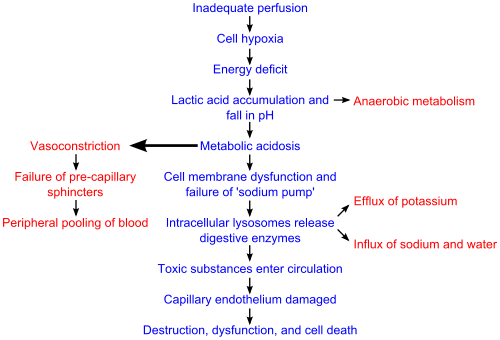
This one also annoys me. Blood loss is not something to play around with. There's a flow chart here. It's a bit complicated, but basically it's describing what happens when there's not proper delivery of oxygen and nutrients to cells and proper removal of waste from cells:

 Image accessed from : http://en.wikipedia.org/wiki/Shock_%28circulatory%29  (1)

Take note of the last one: Destruction, dysfunction and cell death.

Funnily enough, blood brings oxygen and metabolites to the cells. It also takes away waste products. So a lack of blood sets this flow chart into motion. A lack of blood = inadequate perfusion.

Honestly, I'd start to worry about the health of a person once we got past loosing about 750ml of blood. Once a person has lost enough blood to become lethargic or loose consciousness, we're in "blood transfusion plus surgery soon or they'll die" territoy.

The body just can't replace that much blood is such a short time. People don't faint from blood loss and then come back to perfect health all by themselves.


So yes, I hope that helps someone out there. Again, take note of the "student" part of the description I gave before I started this. All this is correct to the best of my knowledge, but in the scheme of things there are plenty of people who have seen a lot more than me, so use this as a jumping off point to research, rather than your only port of call.

Enjoy All,

Sian

1) For referancing purposes, it appears this image was itself based on a information from Alexander, M.F., Fawcett, J.N., Runciman, P.J. (2004) Nursing Practice. Hospital and Home. The Adult.(2nd edition). Edinburgh: Churchill Livingstone